
What does reverse osmosis remove from water?
Short answer: reverse osmosis reduces most of what is dissolved in tap water: heavy metals like lead and arsenic, PFAS (forever chemicals), fluoride, nitrates, sulfate, chloride and other salts, and many pesticides, medications and hormones. In our system, carbon filters before and after the membrane also reduce chlorine, chloramines and trihalomethanes.
No filter removes 100%. How much is reduced depends on the contaminant and the membrane, which is why we say “reduces”.
Contaminant by contaminant
Which stages of our system reduce each one. The main stage is in blue. Each name opens a page with the science and the sources.
| Contaminant | Reduced by | Canadian or Quebec limit |
|---|---|---|
| Lead | RO membraneCarbon block | 0.005 mg/L |
| Arsenic | RO membrane | 0.010 mg/L |
| Mercury | RO membraneGranular carbonCarbon block | 0.001 mg/L |
| Cadmium | RO membrane | 0.005 mg/L |
| Copper | RO membraneCarbon blockGranular carbon | 1.0 mg/L |
| PFAS | RO membraneGranular carbonCarbon block | 30 ng/L |
| Microplastics | RO membraneSediment filter | No limit |
| Fluoride | RO membrane | 1.5 mg/L |
| Nitrates | RO membrane | 10 mg/L |
| Sulfate | RO membrane | 500 mg/L |
| Chloride | RO membrane | 250 mg/L |
| Dissolved solids | RO membrane | 500 mg/L |
| Chlorine and chloramines | Granular carbonCarbon blockFinal carbon | 0.04–2 mg/L |
| Trihalomethanes | Carbon blockGranular carbonFinal carbon | 80 µg/L |
| Pesticides | Carbon blockGranular carbonRO membrane | No single limit |
| Pharmaceuticals | RO membraneCarbon blockGranular carbon | No limit |
| Hormones | RO membraneCarbon blockGranular carbon | No limit |
Limits as shown on each contaminant page (Health Canada or the Quebec standard). “No limit” means Canada and Quebec have not set one.
How each stage helps
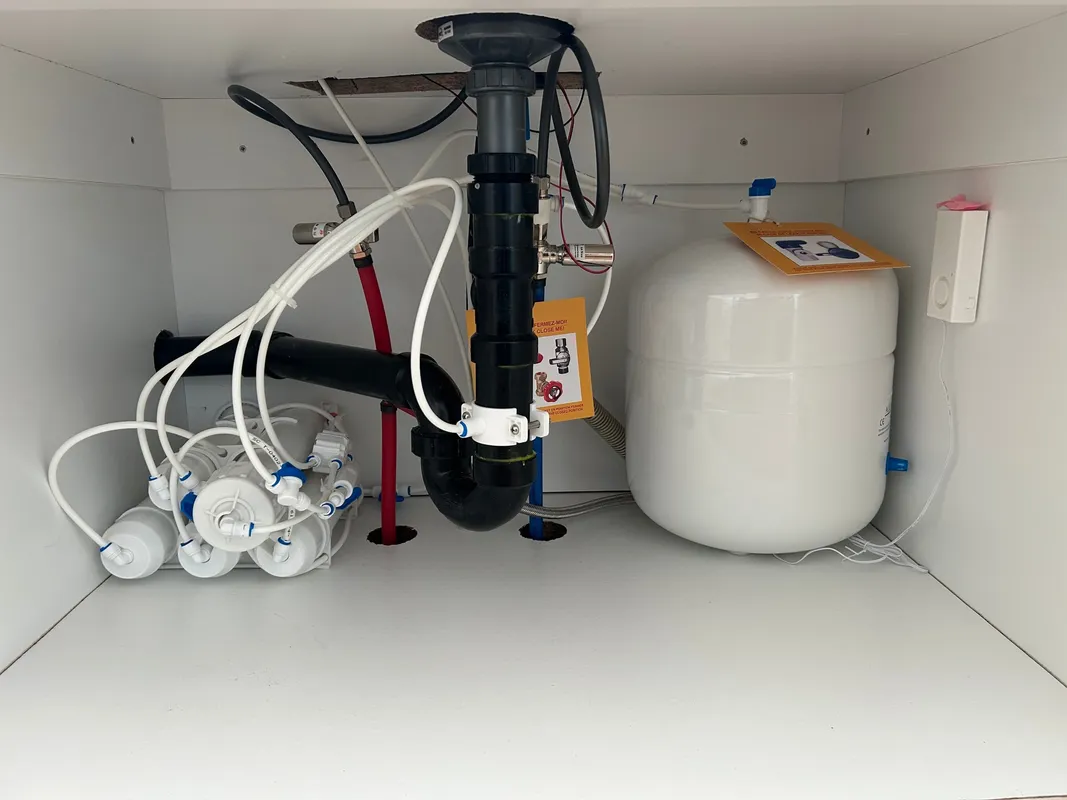
Reverse osmosis is not one filter but a series. Each stage takes care of something, and protects the next one.
Sediment filter
Catches rust, sand and other particles that you can see, and protects the filters after it.
Granular carbon
Reduces chlorine and many chemicals that affect taste and smell.
Carbon block
A denser carbon filter that reduces chloramines, trihalomethanes, many pesticides and more.
Reverse osmosis membrane
The main stage. Water is pushed through a membrane with extremely small pores. Most dissolved metals, salts and chemicals are held back and rinsed down the drain.
Final carbon
Polishes the taste of the water as it leaves the storage tank for your faucet.
Our 6-stage system adds an alkaline filter after the last carbon stage that puts minerals back in and raises the pH. See every stage of the system.
What it doesn’t do
- It only filters the water at your kitchen sink. It doesn’t filter your shower, bath or laundry water. Trihalomethanes, for example, also get into the body through shower steam.
- It is made for treated city water. It is not a way to make unsafe water safe. During a boil-water advisory, follow your city’s instructions, then have the filters changed and the tank disinfected.
- It doesn’t fix the source. With a lead service line, replacing the line is the best fix. Until then, a filter at the tap reduces what reaches your glass.
- Some forms are harder. Reverse osmosis is much less effective on one form of arsenic (arsenic III) that can be found in wells, so well water with arsenic should be tested for its form.
- It also reduces minerals. Calcium and magnesium are held back too. According to Health Canada, drinking water is not a major source of calcium. If you like minerals in your water, read how to add minerals back to RO water.
- Filters don’t last forever. A filter that isn’t changed on time stops doing its job. That’s why we change every filter, even the membrane, every year.
Last reviewed: November 18, 2026
Questions
What does reverse osmosis remove from water?
It reduces most of what is dissolved in water: heavy metals like lead, arsenic, mercury and cadmium, PFAS, fluoride, nitrates, sulfate, chloride and other salts, and many pesticides, medications and hormones. The carbon stages also reduce chlorine, chloramines and trihalomethanes. No filter removes 100%, and how much is reduced depends on the contaminant and the membrane.
Does reverse osmosis remove fluoride?
It reduces it. The reverse osmosis membrane is the stage that does it: carbon filters, like most pitcher and fridge filters, don’t reduce fluoride.
Does reverse osmosis remove bacteria and viruses?
Our system is made for treated city water and we don’t use it as a way to make unsafe water safe. During a boil-water advisory, follow your city’s instructions. Afterwards, we recommend a filter change and a disinfected tank.
Does reverse osmosis remove minerals?
Yes, it also reduces minerals like calcium and magnesium. According to Health Canada, drinking water is not a major source of calcium: most of the minerals your body needs come from food. If you like minerals in your water, you can add mineral drops or a pinch of mineral salt, or choose our 6-stage system.
Does reverse osmosis remove chlorine?
The carbon stages before the membrane reduce chlorine and chloramines, which also protects the membrane. The final carbon filter polishes the taste.
Is reverse osmosis water safe to drink every day?
Yes. It is simply water with most of what was dissolved in it reduced. Most of the minerals your body needs come from food, not water.
Get a free quote
The fastest way is a phone call. You can also leave your number and we’ll call you back.